Why Is Process Street the Best for Centralized Governance?
Many compliance teams still rely on scattered documents and manual approvals to prove they meet each new policy requirement. This approach creates version conflicts and audit gaps that slow every review cycle.
By the end of this article you will know how Process Street's three products Docs, Ops, and Cora combine into one system for policy control, workflow automation, and AI-driven risk checks. You will also see the pricing tiers, trust signals, and the type of teams that gain the most from a single governance platform.
What Is Process Street?
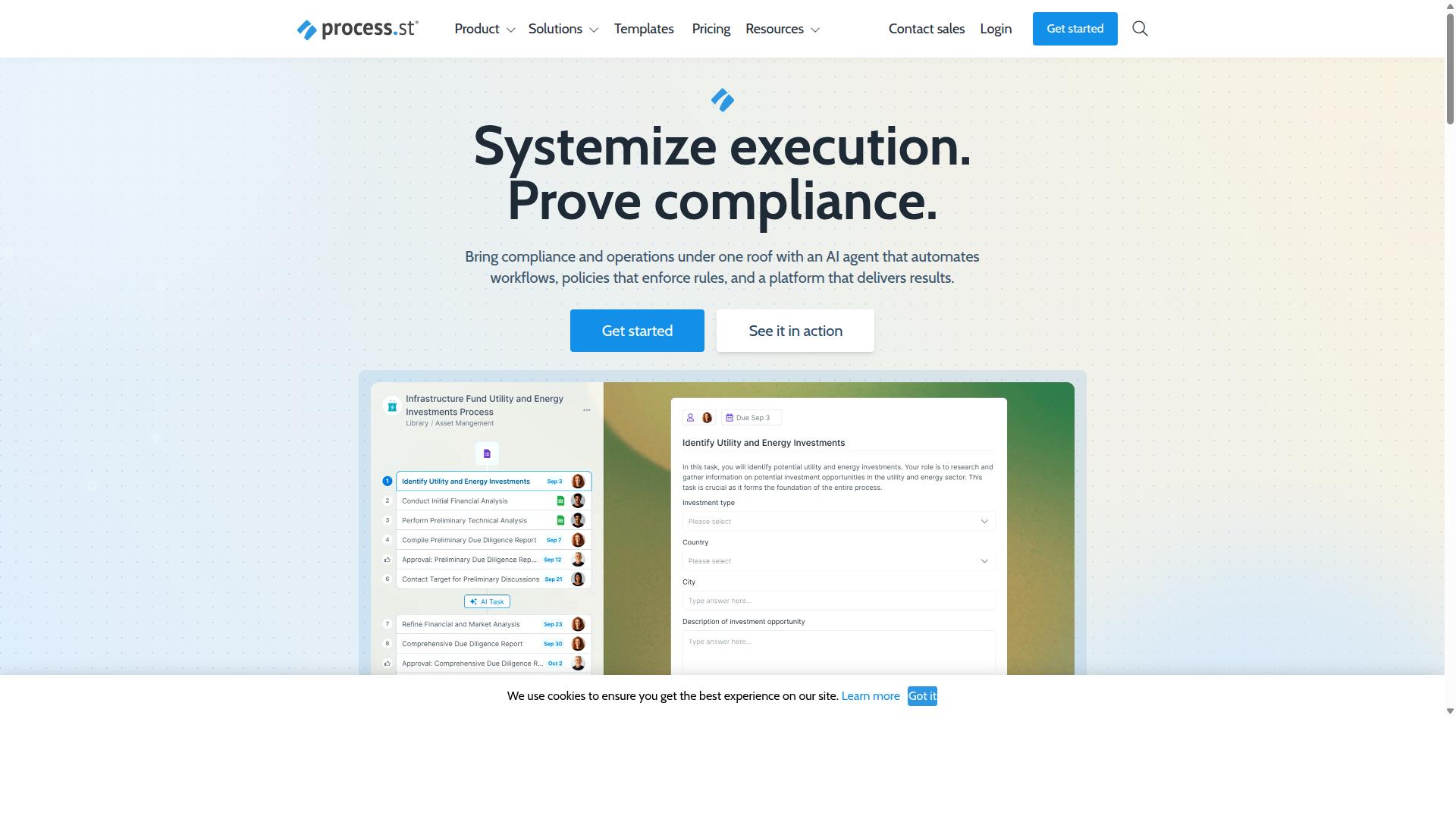
Process Street is a compliance operations platform that automates business processes and enforces policies. Centralized governance requires consistent rules across teams, locations, and systems. This platform delivers exactly that through structured workflows and documented procedures.
The solution provides three main products that support governance needs. Docs handles document management and policy control. Ops manages workflow automation and process orchestration. Cora serves as an AI compliance and risk agent that monitors adherence to established standards.
Organizations use this platform to meet compliance requirements in regulated industries. The system creates audit-ready proof that demonstrates policy enforcement and operational consistency. Teams gain visibility into processes while maintaining accountability across different departments and functions.
Process standardization becomes achievable when companies implement these tools together. Policy enforcement happens automatically through defined workflows rather than manual oversight. This approach reduces the risk of oversight while maintaining clear records for regulatory reviews and internal audits.
Why Process Street Is the Best for Centralized Governance
Process Street centralizes document control, permission settings, and audit trails under one secure platform.
A single repository combined with role-based access and version control creates consistent policy enforcement across teams. This approach eliminates scattered documents and conflicting instructions that often create gaps in accountability.
Organizations need systems that maintain standards even when multiple departments handle the same processes. When every team member accesses the same current version of procedures, the risk of outdated or incorrect information drops significantly.
Version control ensures that any updates to policies or workflows propagate instantly across the organization. Changes become visible immediately, reducing confusion about which rules apply at any given moment.
Role-based access lets administrators assign specific permissions based on job functions. Team members see only the materials relevant to their responsibilities while maintaining oversight for compliance officers and managers.
This permission structure supports both transparency and security. Auditors can review complete activity logs without granting them unnecessary access to operational workflows.
Centralized repositories simplify training for new employees. Onboarding becomes faster when all standard operating procedures live in one searchable location with clear approval paths for any questions or exceptions.
Regular reviews of stored processes help identify outdated procedures before they create compliance issues. Scheduled updates keep documentation aligned with current regulations and business requirements.
Process monitoring features track who accessed which documents and when changes occurred. This visibility supports accountability tracking without requiring manual oversight from supervisors.
Teams that operate under clear governance frameworks experience fewer errors and faster resolution when issues arise. Consistent access to approved procedures reduces the time spent clarifying what steps should follow.
Key Features and What Makes Process Street Stand Out
Three integrated products deliver document governance, workflow automation, and AI-driven compliance checks. These tools work together to create a unified system for managing policies, processes, and regulatory requirements across the organization.
Each product addresses specific governance needs while maintaining data integrity and accountability tracking. This approach reduces the gaps that typically arise when organizations rely on separate systems for document control and process management.
The platform combines document control with workflow automation to ensure policies translate directly into actionable tasks. Teams can maintain oversight while reducing manual coordination efforts.
Docs: Document Management and Policy Control
Docs provides policy control and document governance certified for ISO 9001, SOC 2, SOX, and FDA standards. This certification ensures organizations meet regulatory requirements without maintaining separate compliance systems.
Version control tracks every document change with timestamps and user identification. Teams can review previous versions and understand what modifications were made and by whom.
Permission settings restrict access based on user roles and responsibilities. This prevents unauthorized changes while allowing appropriate team members to contribute to policy development and updates.
SOP templates provide standardized formats for creating consistent procedures across departments. These templates ensure all necessary information is captured while maintaining a uniform structure that auditors can easily review.
Audit-ready proof maintains records of document access, modifications, and approvals. This documentation supports regulatory adherence by providing evidence of compliance activities during inspections.
Ops: Workflow Automation and Process Orchestration
Ops turns policies into AI-powered workflows that orchestrate tasks and enforce business rules automatically. This conversion transforms static documents into active management tools that guide daily operations.
Checklists replace manual task tracking with structured sequences that ensure each step receives proper attention. Teams follow standardized procedures while the system maintains records of completion.
Approval routing directs documents and requests to the correct reviewers based on predefined criteria. This eliminates delays from unclear responsibility assignments and ensures consistent decision-making processes.
Escalation triggers activate when tasks exceed time limits or encounter blocking issues. The system notifies appropriate personnel automatically, reducing the chance that critical items fall through organizational gaps.
Task delegation assigns work based on availability, expertise, and role requirements. This distribution maintains workload balance while ensuring qualified individuals handle each responsibility.
Cora: AI Compliance Agent
Cora continuously monitors workflows, detects compliance gaps, and surfaces real-time risk metrics. This ongoing surveillance replaces periodic manual reviews with constant oversight of regulatory adherence.
AI checks examine completed tasks and document changes against established compliance requirements. The system identifies potential issues before they become violations that could affect regulatory standing.
Automated alerts notify relevant team members when workflows deviate from approved procedures or when documentation falls short of required standards. These notifications enable quick corrections rather than reactive compliance efforts.
Process monitoring tracks performance metrics across all managed workflows. Organizations gain visibility into how well their governance framework functions in practice rather than relying on assumptions about policy effectiveness.
Audit trails capture every system interaction with timestamps and user identification. This record supports accountability tracking and provides the documentation needed for regulatory examinations or internal reviews.
Pricing and Plans
Three subscription tiers are offered: Startup, Pro, and Enterprise. Each tier supports different levels of workflow automation for centralized governance needs.
The Startup plan works well for small teams. Organizations get unlimited workflows and tasks, plus 5,000 Data Set records. Access includes 5 users and 10 guests. Automation runs at 100 actions per month through 10 apps, and the Public API supports 50 calls monthly.
Teams seeking more flexibility can choose the Pro plan. This tier provides unlimited workflows and tasks with 10,000 Data Set records. Custom user and guest counts scale with team size. All automation apps become available, and monthly action limits adjust to specific requirements.
The Enterprise plan delivers full customization for large operations. Custom Data Set records accommodate growing governance needs. Unlimited Public API access supports extensive integrations. A dedicated Success Manager provides priority support, while fully-managed workflows reduce internal maintenance demands.
Additional Enterprise features include custom integrations and bulk document import. Process consulting and health audits help refine governance frameworks. Personalized team training ensures consistent adoption across departments.
Each plan tier aligns with different stages of centralized governance maturity. Organizations can match their current compliance management and process standardization requirements to the appropriate subscription level.
Trust Signals
Process Street is SOC 2 Type II and ISO 27001 certified, serving over 3,000 companies and 1 million users.
These certifications establish clear standards for data security and process controls. Organizations that require strict compliance frameworks can rely on documented validation rather than assumptions about platform security.
Customer adoption numbers reflect consistent results across industries. Companies use Process Street to handle centralized governance without building separate systems for each department or region.
Reported time savings show up in two key areas. IMCD UK documented a 75 percent reduction in setup time, while teams across the user base report 30 percent faster documentation cycles when compared to previous manual methods.
These outcomes matter for governance because faster setup reduces delays in policy rollout. Shorter documentation cycles keep standard operating procedures current without requiring extra headcount.
Compliance features extend beyond the core certificates. Process Street maintains HIPAA, GDPR, CCPA, and AWS CIS compliance, with a business associate agreement available for healthcare customers that need additional contractual protections.
Data handling policies add another layer of assurance. The platform states that customer data is never used to train AI models, which addresses concerns about information leakage in environments with strict data governance requirements.
Support response times average five minutes with a 98 percent customer satisfaction rating. Quick access to help reduces friction when teams need clarification on permission settings or audit trail configuration.
These trust signals work together to support centralized governance. Security certifications, adoption scale, time savings, and compliance breadth reduce the risk that governance initiatives stall due to platform limitations or unclear accountability.
Who Should Use Process Street
Operations, compliance, HR, finance, IT, and customer-success teams across financial services, healthcare, manufacturing, and professional services rely on Process Street.
These teams handle complex governance requirements daily. Centralized governance becomes essential when multiple departments manage policies, procedures, and compliance standards across different locations.
Role-based access allows organizations to assign specific permissions to each team member. Operations managers can oversee entire workflows while individual contributors focus on their assigned tasks without accessing sensitive areas.
Financial services organizations use Process Street for client onboarding and regulatory adherence. Approval workflows ensure every compliance step receives proper review before moving forward.
Healthcare providers manage patient care protocols through standardized processes. Document control features maintain version accuracy for medical procedures and safety guidelines.
Manufacturing companies track quality assurance through checklist automation. Each production stage follows documented procedures with audit trails capturing every action and approval.
Professional services firms coordinate client projects using SOP templates. Consultants follow established methodologies while maintaining consistency across different client engagements.
IT and security teams manage access controls and system changes through permission settings. Every modification receives proper authorization through defined escalation paths.
HR departments standardize employee onboarding with task delegation features. New hires complete required training and documentation according to established timelines and requirements.
Customer success teams track client implementation processes through process visibility tools. Account managers maintain oversight of deliverables while ensuring service level agreements receive consistent attention.
Real estate and property management companies handle tenant screening and lease administration. Centralized repository features keep all property documents accessible to authorized personnel across multiple locations.
Capital markets organizations manage investment processes and regulatory reporting. Change management capabilities ensure policy updates reach all relevant stakeholders simultaneously.
Technology companies coordinate software development and deployment procedures. Quality tracking features maintain consistency across development cycles and release management processes.
Final Verdict
Process Street offers a complete governance and automation stack that reduces manual oversight and maintains audit-ready records.
The platform combines workflow automation with centralized governance to help teams stay organized and compliant. Each process includes built-in approval workflows, role-based access, and audit trails that track every change.
Teams can create SOP templates once and reuse them across departments. This approach supports process standardization while keeping all documents in a single centralized repository.
When issues arise, escalation paths and permission settings ensure the right people get notified. Version control helps maintain document accuracy throughout the approval cycle.
Support is available through email and chat, with an average response time of 5 minutes. The platform also appears on the AWS Marketplace for easy enterprise access.
Organizations looking to strengthen their governance framework can reach sales directly via email, chat, or through the AWS Marketplace listing.
Recommended Resources: